

As climate change, desertification, drought, and the increasing frequency of dzuds continue to affect Mongolia, they are having adverse impacts on the livelihoods of rural communities and, consequently, are increasingly contributing to migration from rural areas to Ulaanbaatar and other provinces.
In particular, for people whose livelihoods depend heavily on livestock herding, environmental and climate-related risks, such as drought, dzud, and pasture degradation, have become significant factors affecting their sources of livelihood. At the same time, people are increasingly relocating to Ulaanbaatar for various socio-economic reasons, including seeking employment, attending schools and training courses, accessing education, healthcare and social welfare services, and receiving medical treatment.
However, in the central region, particularly in Darkhan-Uul, Selenge, and Tuv provinces, a trend of migration from other parts of the country has been observed, primarily driven by opportunities to engage in crop farming.
Let us take a look at migration to Ulaanbaatar:
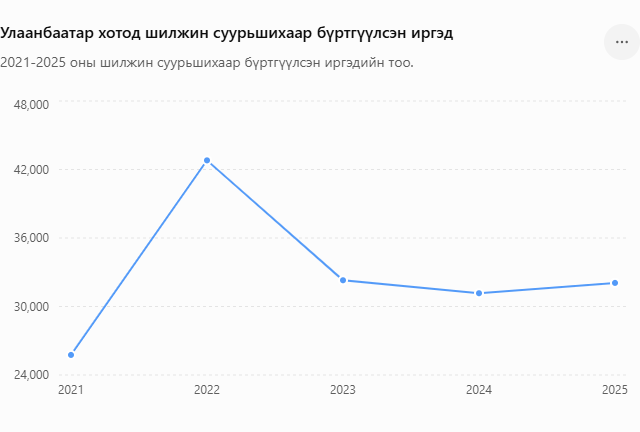
According to the data on citizens registered as having relocated to Ulaanbaatar between 2021 and 2025, the highest number was recorded in 2022, with a total of 42,800 citizens.
- 2021 – 25,758
- 2022 – 42,800
- 2023 – 32,298
- 2024 – 31,162
- 2025 – 32,067 citizens.
While the number of people migrating to Ulaanbaatar increased sharply in 2022, it fluctuated between approximately 31,000 and 32,000 per year during 2023–2025, remaining relatively stable thereafter.
Citizens registered as having relocated/moved to Ulaanbaatar
Number of people registered as having relocated/moved to Ulaanbaatar, 2021–2025
.png)
By region:
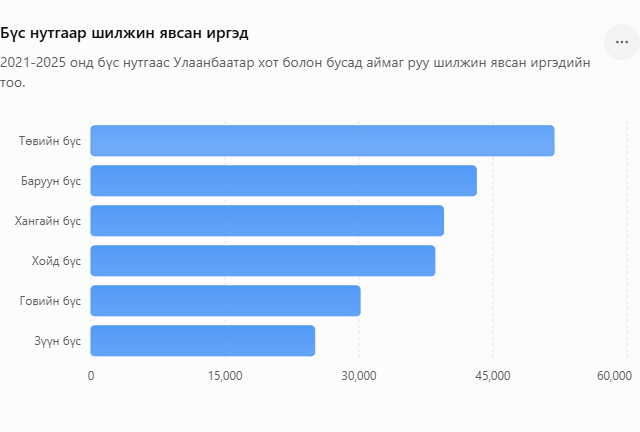
Between 2021 and 2025, when the number of people who moved from rural areas to Ulaanbaatar and other provinces is analyzed by region, the highest number, 51,825 people, moved from the Central Region. This was followed by 43,129 people from the Western Region, 39,459 from the Khangai Region, 38,492 from the Northern Region, 30,121 from the Gobi Region, and 25,042 from the Eastern Region.
Thus, a total of 228,068 people moved from these six regions to Ulaanbaatar and other provinces and localities during the period from 2021 to 2025.
Regional Migration
The number of people who moved from the regions to Ulaanbaatar and other provinces during 2021–2025.
The above data indicate that internal migration in Mongolia is influenced by a range of factors, including not only environmental and climatic factors such as climate change, desertification, drought, and dzud, but also employment, education, healthcare, and access to social services.
Therefore, supporting sustainable livelihoods in rural areas, enhancing people’s capacity to adapt to climate change, and improving access to education, healthcare, employment, and social services are crucial to reducing the concentration of migration in urban areas.
